The Fiber Gap: Why Most People Fall Short and 10 Simple Ways to Hit 30 g a Day
Here is a nutritional fact that stops most people in their tracks: only about 5% of adults in North America consistently meet their daily fiber target. Not 50%. Not 25%. Five percent. And yet, ask anyone whether they eat enough fiber and the majority will confidently say yes.
That disconnect — between perception and reality — is what researchers and public health professionals have come to call the fiber gap, and it is one of the most significant missed opportunities in preventive nutrition today. We know, from decades of robust population research, that adequate fiber intake is associated with meaningfully lower rates of cardiovascular disease, type 2 diabetes, colorectal cancer, and obesity. A landmark 2019 meta-analysis commissioned by the World Health Organization and published in The Lancet found that each additional 8 grams of fiber per day was associated with a 5 to 27 percent reduction in cardiovascular disease, diabetes, and colorectal cancer risk. The benefits were dose-dependent and held across multiple study designs — this is not fringe science.
And yet the average adult consumes somewhere between 14 and 16 grams of fiber per day, roughly half the recommended amount for women and less than half for men. In a landscape where protein is plastered across every food label and fibermaxxing has become a trending wellness term for 2026, most of us are still dramatically underestimating what closing this gap actually requires — and how straightforward it can be.
This article will explain exactly what the fiber gap is, walk you through the evidence on why it matters across multiple systems in your body, and give you 10 specific, realistic, whole-food strategies to hit 30 grams or more a day. No supplements required, no dramatic diet overhaul — just a clear pattern shift that most people can start today.
What Is the Fiber Gap? The Numbers You Need to Know
Dietary fiber is the indigestible portion of plant foods — the structural material that holds plant cells together and passes through your digestive system largely intact. It is found exclusively in plant-based foods: fruits, vegetables, legumes, whole grains, nuts, and seeds. Your body cannot break it down the way it does proteins, fats, or starches, and that is precisely the point. It is that resistance to digestion that allows fiber to do its most important work.
The recommended daily fiber intake for adults in Canada and the United States is based on the 2020–2025 Dietary Guidelines for Americans and the Institute of Medicine's Adequate Intake values:
Women under 51: 25–28 g/day
Women over 51: 21 g/day
Men under 51: 34–38 g/day
Men over 51: 30 g/day
A useful shorthand from the USDA: aim for 14 grams of fiber per 1,000 calories consumed. For a standard 2,000-calorie diet, that works out to about 28 grams — a reasonable middle-ground target for most adults.
Now consider that the average North American adult consumes somewhere between 14 and 16 grams of fiber per day. Research published in Frontiers in Nutrition in 2025 found that approximately 97% of men and 90% of women do not meet their recommended fiber intake. A Food & Fiber Summit analysis presented at the National Institutes of Health found something even more striking: most consumers believe they already eat enough fiber. The awareness gap and the intake gap exist simultaneously — and that combination is what makes the fiber gap so stubbornly persistent.
Most people think they eat enough fiber because they occasionally have a salad or eat whole wheat bread. But a typical iceberg lettuce salad might deliver 2 grams. A slice of so-called 'whole wheat' bread often adds another 2 grams. Closing the fiber gap requires intentional, consistent choices — not occasional ones.
What is driving the shortfall? Several factors compound one another. Ultra-processed foods dominate modern diets and are stripped of naturally occurring fiber. Protein marketing has taken up most of the nutritional conversation on product packaging. Whole grain labeling is confusing — not all 'whole grain' products are high in fiber, and the only reliable check is reading the Nutrition Facts panel for grams per serving. Add busy lifestyles, convenience-food reliance, and meals eaten on the go, and the fiber gap becomes almost inevitable without deliberate effort.
Why Closing the Fiber Gap Matters: The Evidence Is Hard to Ignore
Fiber's most famous reputation is digestive — most people associate it with regularity, and that is a fair association. But the research case for fiber extends into almost every major chronic disease area. Here is what the evidence actually shows.
Heart health
Soluble fiber — particularly the beta-glucan found in oats and barley, and the pectin in apples and citrus — forms a viscous gel in the digestive tract that binds to bile acids and cholesterol, preventing their reabsorption and lowering circulating LDL cholesterol levels. Research published in Frontiers in Nutrition (2024) confirmed that dietary fibers, particularly soluble types, can reduce LDL cholesterol, improve lipid profiles, and support endothelial function, reducing cardiovascular disease risk. An umbrella review in the American Journal of Clinical Nutrition found highly significant associations between higher fiber intake and reduced risk of coronary artery disease, cardiovascular disease mortality, and stroke.
For anyone managing dyslipidemia or looking to support heart health through food, this is one of the most well-evidenced dietary levers available — and it costs nothing beyond a shift toward legumes, oats, and whole fruits.
Blood sugar and type 2 diabetes risk
Soluble fiber slows carbohydrate absorption by increasing the viscosity of gut contents, blunting the post-meal glucose spike and reducing insulin demand over time. The Lancet meta-analysis (2019) found that each 8-gram daily increase in fiber intake was associated with up to a 40% reduction in type 2 diabetes risk across pooled data from hundreds of studies. Beta-glucan and psyllium husk are among the most extensively studied fiber types for glycemic control, and both have been incorporated into clinical dietary guidance for blood sugar management.
Gut health and the microbiome
This is where fiber's role becomes genuinely fascinating. Dietary fiber is the primary fuel source for the beneficial bacteria that live in your large intestine. When those bacteria ferment fiber, they produce short-chain fatty acids — butyrate, propionate, and acetate — that nourish the cells lining your colon, reduce intestinal inflammation, and support gut barrier integrity. Different fiber types feed different bacterial species, which is why diversity of plant foods matters as much as total fiber quantity.
Prebiotic fibers — including inulin (found in garlic, onions, and Jerusalem artichoke), resistant starch (green bananas, cooled cooked potatoes), and beta-glucan — selectively feed Bifidobacterium and Lactobacillus species, which are consistently associated with positive health outcomes across immunity, mood, metabolism, and beyond.
Weight management and satiety
Fiber-rich foods are volumetrically filling: they take up space in the stomach, slow gastric emptying, and trigger satiety hormones earlier in a meal. This translates into reduced total calorie intake without active calorie restriction. Viscous soluble fibers — psyllium, guar, and konjac (glucomannan) — have the strongest evidence for satiety and weight-related outcomes in clinical trials.
This dynamic is particularly relevant in 2026. As GLP-1 medications like Ozempic and Wegovy become more widely used, the importance of nutrient-dense, fiber-rich eating increases rather than decreases. Reduced appetite on these medications makes every bite count even more — fiber supports the satiety goals of reduced-volume eating while helping to prevent the constipation that many GLP-1 users experience.
Colorectal cancer risk
Insoluble fiber speeds transit time through the colon, reducing the duration that potential carcinogens remain in contact with the intestinal wall. The fermentation of fiber also produces butyrate, which has shown anti-proliferative effects on colon cells in research settings. The Lancet/WHO meta-analysis found a 15 to 20 percent lower incidence of colorectal cancer associated with higher fiber intake, and the AJCN umbrella review extended significant associations to pancreatic and gastric cancer outcomes.
If fiber were a drug with this evidence base, it would be a blockbuster. It just happens to come in the form of beans, oats, and raspberries.
Not All Fiber Is the Same: A Quick Guide
Before getting into practical strategies, it helps to understand that fiber is not one thing — it is a broad family of plant compounds that behave differently in the body. You do not need to memorize the taxonomy, but a basic understanding explains why variety matters more than any single source.
Soluble fiber dissolves in water and forms a gel-like substance in the gut. It is the type most associated with cholesterol lowering, blood sugar stability, and satiety. Key sources: oats, beans, lentils, apples, citrus fruits, psyllium, barley.
Insoluble fiber does not dissolve in water and adds bulk to stool, speeding transit through the colon. It supports regularity and is most directly associated with colorectal cancer risk reduction. Key sources: whole wheat, bran, most vegetables, nuts, seeds.
Prebiotic fiber is a subtype of soluble fiber that selectively feeds beneficial gut bacteria. Key types include inulin, fructooligosaccharides (FOS), beta-glucan, and resistant starch. Key sources: garlic, onions, leeks, asparagus, slightly underripe bananas, oats.
Key takeaway: Most whole plant foods contain a mix of soluble and insoluble fiber. Eating a variety of fruits, vegetables, legumes, whole grains, nuts, and seeds is the most practical and effective way to cover all your bases — no tracking required.
Top High-Fiber Foods at a Glance
Use this reference table when building meals and snacks. Fiber values are approximate and may vary by variety, brand, or preparation method. Source: USDA FoodData Central.
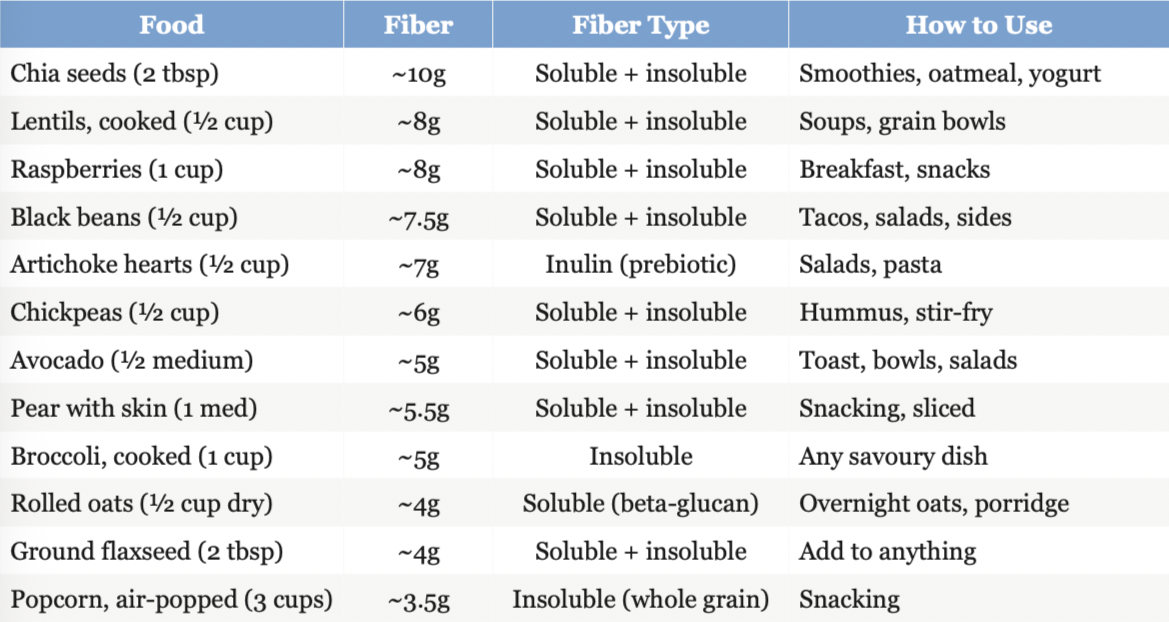
A few things worth noting from this table: chia seeds and lentils are the most fiber-dense options by serving, which is why they appear prominently in the practical strategies below. Legumes as a category are among the most powerful whole-food fiber sources available, and they are also among the most affordable.
10 Simple Ways to Hit 30 g of Fiber a Day
These strategies are ordered by impact-to-effort ratio — the ones that deliver the most fiber with the least friction come first. You do not need to implement all ten at once. Start with one or two, let them become habitual, and build from there.
1. Add chia seeds or ground flaxseed to breakfast — every day
This is the highest-impact, lowest-effort habit in this list. Two tablespoons of chia seeds deliver approximately 10 grams of fiber alone. Two tablespoons of ground flaxseed add another 4 grams. Stir chia seeds into overnight oats or Greek yogurt, blend them into a smoothie, or mix ground flaxseed into your morning porridge. This single habit can add 10 to 14 grams to your daily total before you have left the kitchen.
Ground flaxseed (not whole) is the form your body can actually use — whole flaxseed passes through largely undigested.
2. Make legumes a weekly staple — aim for at least three servings
Half a cup of cooked lentils, black beans, or chickpeas provides 6 to 8 grams of fiber per serving — making legumes one of the most fiber-dense foods available, gram for gram. They are also among the most affordable items in the grocery store. Canned beans are just as nutritious as dried and require zero preparation time: rinse, drain, and add to whatever you are already making.
The practical entry points are endless: toss chickpeas into a stir-fry, stir black beans into scrambled eggs or a grain bowl, simmer a pot of lentil soup on Sunday and portion it out for the week. Three servings of legumes adds 18 to 24 grams of fiber before counting anything else.
3. Swap your grains strategically — and check the label
Not all grain swaps are equal, and this is where many people stumble. 'Whole grain' on packaging does not guarantee high fiber content. The only reliable approach is to read the Nutrition Facts panel and look for at least 3 grams of fiber per serving (5 grams marks an 'excellent source').
Practical upgrades that actually move the needle: replace white rice with brown rice (+2 g per cup) or try lentil-based pasta for a dramatic fiber jump. Rolled oats at breakfast deliver about 4 grams of fiber before you add anything. Air-popped popcorn — a whole grain — provides 3.5 grams of fiber for 3 cups, making it one of the better high-fiber snacks available.
4. Keep the skin on your fruit
The skin of fruit contains a disproportionate share of its total fiber. An apple eaten with its skin delivers approximately 4.4 grams of fiber; peeled, that drops to around 2 grams. A pear with skin provides 5.5 grams. This applies across most fruits — peaches, kiwi, and apricots are all meaningfully higher in fiber when the skin is eaten.
This one requires zero extra effort, no recipe changes, and no additional food purchase. Just stop peeling.
5. Build a high-fiber breakfast by default
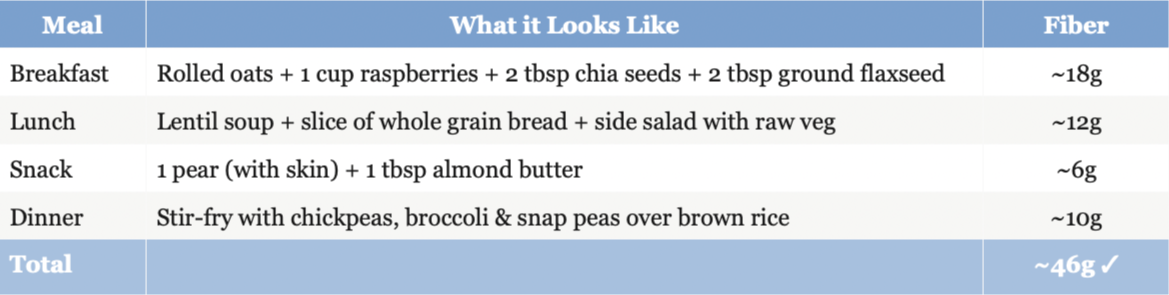
Breakfast is the easiest meal to systematically load with fiber, and doing so sets the nutritional tone for the day. A bowl of rolled oats topped with a cup of raspberries, two tablespoons of chia seeds, and two tablespoons of ground flaxseed delivers approximately 18 grams of fiber before 9 a.m. — more than most people eat in an entire day. That is more than half the daily target, handled in one meal.
On busier mornings, a high-fiber cereal (look for 5 g or more per serving) with berries and a tablespoon of chia seeds is a reliable backup. Smoothies can be another vehicle: spinach, frozen berries, chia, and ground flax blended together add 8 to 10 grams with minimal effort.
6. Use avocado as a fiber vehicle, not just a fat source
Half an avocado provides about 5 grams of fiber from a combination of soluble and insoluble types. That is meaningful on its own — but the real value of avocado is its versatility as a base that pairs with almost any meal. Add it to eggs, grain bowls, salads, or toast. Use it as a dip in place of hummus. Slice it alongside any protein-based meal to add fiber without changing the character of the dish.
7. Snack smarter — make the swap from low-fiber to high-fiber options
Snacks are a significant missed opportunity. Most common snack foods — crackers, chips, rice cakes, pretzels — deliver very little fiber. Replacing even one of those daily snacks with a whole-food option adds meaningful fiber without requiring any extra meal preparation.
High-impact swaps: an apple or pear with nut butter (4–6 g), raw vegetables with hummus (3–5 g), a small handful of mixed nuts and seeds (2–4 g), or a cup of berries (3–8 g depending on variety). These are not exotic substitutions — they are familiar foods that simply require you to choose them deliberately.
8. Fill at least half your plate with vegetables at every main meal
Harvard Health recommends aiming for at least half the plate to be fiber-rich foods at lunch and dinner. The most fiber-dense vegetable options to prioritize: broccoli (5 g per cooked cup), Brussels sprouts (4 g per cooked cup), artichoke hearts (7 g per half cup), sweet potato with skin (4 g per medium), and snap peas (2 g per cup raw).
The most practical way to make this habitual: batch roast a large tray of mixed vegetables at the start of the week. Remove the daily friction of preparation and the choices become easier to make consistently.
9. Include at least one prebiotic-rich food daily
Prebiotic fibers do more than add to your total fiber count — they selectively nourish the gut bacteria most associated with positive health outcomes. Even small amounts make a meaningful difference: a clove of garlic, half an onion cooked into a dish, a small serve of asparagus, or a slightly underripe banana as a snack.
These foods do not need to be the star of a meal to be effective. Garlic and onion cooked into a base for soups, stews, or sautéed vegetables counts. Sliced banana stirred into oatmeal counts. The key is making at least one prebiotic source a daily habit rather than an occasional feature.
10. Increase slowly — and drink more water
This final point is protective rather than additive: jumping from 15 grams to 40 grams of fiber overnight is a reliable way to experience significant bloating, gas, and cramping — and to give up entirely before the habit takes hold. The clinically recommended approach is to increase by approximately 5 grams per week, giving your gut microbiome time to adapt to the new substrate load.
Equally important: water. Fiber absorbs fluid and requires it to move efficiently through the digestive tract. Without adequate hydration, a dramatic increase in fiber can actually worsen constipation rather than relieve it. Aim for approximately 2 litres of fluid per day — more in warm weather or with significant physical activity — as you build toward your fiber target.
What 30 g+ of Fiber Looks Like in a Real Day
One of the most common reactions to fiber recommendations is: I have no idea what 30 grams of fiber actually looks like. Here is a concrete example using real, accessible foods — no supplements, no specialty ingredients, no calorie counting required.
A Word on Fiber Supplements
Fiber supplements — psyllium husk, beta-glucan, glucomannan, guar fiber — can be useful tools in specific circumstances, particularly for people with certain digestive conditions, those eating significantly reduced food volumes on GLP-1 medications, or anyone struggling to meet targets through food alone during a transition period.
That said, whole foods remain the gold standard. A supplement delivers fiber — and only fiber. A cup of lentils delivers fiber alongside iron, folate, plant protein, magnesium, and phytonutrients that work synergistically in ways a powder cannot replicate. The population-level research linking high fiber intake to better health outcomes is almost entirely based on whole-food dietary patterns, not supplementation.
If you are considering a supplement, psyllium husk has the strongest and broadest evidence base — it is well-studied for constipation, IBS symptom management, LDL reduction, and blood pressure support. Beta-glucan is most relevant for cholesterol and glycemic control. Always speak with a registered dietitian before adding a supplement if you have an existing digestive condition, as the right type of fiber matters as much as the quantity.
Common Fiber Mistakes Worth Avoiding
Assuming 'whole grain' means high fiber. It often does not. Check the label for at least 3 g of fiber per serving before counting on it.
Increasing fiber too fast. Bloating and gas are the most common reasons people abandon a high-fiber diet. Go up by 5 g per week.
Not drinking enough water. Fiber needs fluid to function. Dehydration combined with high fiber intake leads to constipation, not relief.
Relying only on supplements. They fill a gap, but they cannot replace the nutritional matrix of whole plant foods.
Thinking fiber is only about digestion. The cardiovascular, metabolic, and cancer-risk benefits are equally — arguably more — significant.
Eating the same fiber sources repeatedly. Microbiome diversity requires dietary diversity. Rotate your fruits, vegetables, legumes, and grains.
The Bottom Line: Closing the Fiber Gap Is Simpler Than You Think
The fiber gap is not a minor nutritional footnote — it is a population-wide shortfall with measurable consequences for cardiovascular health, metabolic function, gut integrity, and cancer risk. And it is almost entirely reversible through food.
You do not need to overhaul your diet to close the gap. You need a pattern: a fiber-loaded breakfast that becomes non-negotiable, legumes appearing at least three times a week, fruit eaten with its skin, half your plate covered in vegetables at every savoury meal, and a slow, steady increase that gives your gut time to adapt.
Most people who start this process are surprised by how quickly the changes feel normal — and how good their digestion, energy, and satiety levels start to feel once fiber intake consistently hits its target.
Key takeaways at a glance
Only 5% of adults meet their daily fiber target — the fiber gap is one of the most pervasive nutritional shortfalls in the modern diet
Adequate fiber is associated with lower rates of cardiovascular disease, type 2 diabetes, colorectal cancer, and obesity — the evidence base is robust and replicated
Whole foods are always the best source: legumes, fruits, vegetables, whole grains, nuts, and seeds
Start with the highest-impact, lowest-effort habits: chia seeds at breakfast, legumes three times a week, keeping skin on fruit
Increase gradually (by ~5 g per week) and drink plenty of water to avoid the bloating and discomfort that derail most early attempts
Diversity of plant foods matters — eat a variety of fiber types to support a diverse, thriving gut microbiome
Ready to close your fiber gap?
Start with just one change this week: add 2 tablespoons of chia seeds or ground flaxseed to your breakfast. Track how you feel over the next 7 days — most people notice a difference in digestion and satiety within a week.
If you have a digestive condition, are on a GLP-1 medication, or are unsure which fiber sources are right for your situation, a registered dietitian can build a personalized plan that accounts for your specific needs. Book a consultation to get started.